Neoprene Swim Shorts: Swim Like Open Water in the Pool… and Faster in Both
If your open water swimming races and other events happen in a wetsuit but most of your training happens in a pool, you're spending months preparing without an important element of the "race day" feeling. Neoprene swim shorts close that gap. And they'll make you swim faster from the moment you pull them on.
For open water swimmers in most of North America, the compressed open water season is eagerly awaited through the colder months. Lake Michigan temperatures here in Chicago start permitting open water swimmers to test their cold water tolerance (beyond a quick cold plunge) in April or May. More comfortable water might arrive in June. Before then, serious preparation for summer swims and races happens almost entirely in the pool.
Training Through Winter with Open Water Specific Preparation
If you prefer a wetsuit in the open water or your event requires it (like the Mackinac Bridge Swim), laps in the pool without a wetsuit feel different. Pull on a full wetsuit, the buoyancy lifts your hips and legs, your body rides higher, your stroke feels different, and the effort required to maintain a long body position is less. But the months of training without that sensation have led you to adapt your stroke and timing to a very different swimming experience.
Good neoprene swim shorts can fix this. A pair of neoprene swim shorts provides meaningful buoyancy to the hips and legs, holds your body in that higher “downhill” position, and does it in roughly the size and profile of a jammer. The good ones go on and peel off quickly, they’re inconspicuous in the pool. Governing bodies for triathlon and open water swimming classify them as a wetsuit, making it legal for wetsuit-permitted races. They’ve become a fixture in our training kit for much of the year.
The Big Problem They Solve
The most common body position error among newer swimmers and our fellow adult-onset swimmers is the uphill swim: legs and feet sinking, hips dragging low. It’s a high-drag position that costs significant time and energy. A pull buoy addresses it, but it removes the kick entirely and doesn’t feel remotely like wetsuit swimming.
Neoprene shorts solve the body position problem while leaving your kick intact. The buoyancy in the hips and legs corrects body position naturally; you’re just swimming, with your body where it should be. For many swimmers, this is immediately recognizable: hips high, feet near the surface, the kind of flat efficient position that the best swimmers produce naturally. Several manufacturers also claim meaningful core support that helps maintain a long axis position, similar to what a well-designed full wetsuit provides.
In our testing, wearing the neoprene was consistently good for 3 to 7 seconds per 100 yards / meters. Intermediate to advanced swimmers with good body position may see the lower end of that range; swimmers still working on body position will see more.
Warmth at the Margins
There’s a secondary benefit worth mentioning for swimmers seeking minimalist open water swimming gear choices: incremental warmth. When water temperatures are below fully comfortable for non-wetsuit, somewhere around 63°F (17°C) for us, adding neoprene shorts and a neoprene cap extends the comfortable swimming range meaningfully. For much of a Chicago-area summer, with Lake Michigan temperatures hovering from from 60°F to the low 70s°F (15-21°C), neoprene shorts are the only wetsuit in our use for months at a time. They’re not a substitute for a full wetsuit in cold water, but at the margins, they’re a practical solution that packs easily and doesn’t require pulling on a full suit.
If you’re swimming warmer water higher than 76°F (25°C), the neoprene shorts deliver the posture benefits without the genuine hazard of being too warm in a full wetsuit.
The Zone3 Options
Zone3 claims to have invented this category in 2017 and has refined it across several distinct models. Our experience with their construction has been consistently positive; seams hold up well, and the waistband durability has been better than most alternatives through extended pool use.
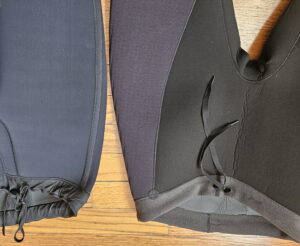
The Zone3 Buoyancy Shorts “The Originals” are the general-purpose model: 3mm neoprene in the center panels and 5mm on the sides, constructed from Yamamoto Smoothskin neoprene for a hydrodynamic surface to reduce drag against the water. These cover the full range of benefits: buoyancy, core support, hip rotation, and reduced drag. For a swimmer who wants a single pair that does everything reasonably well, the Originals are the default choice.
The Zone3 Active is a thinner 3:2mm construction for swimmers whose body position is already solid, or is improving toward that ideal. It offers less buoyancy and places more emphasis on core support to maintain a long axis position, with the same Smoothskin front panel for reduced drag. If you’re an intermediate or advanced swimmer using shorts primarily to simulate wetsuit swimming and develop efficiency rather than to correct body position, the Active is worth considering over the Originals.
At the top of the Zone3 line the Premium Aerodome Elite uses two different types of advanced neoprene: one that gives the highest claimed buoyancy (30%) without increased thickness or bulk, the other that gives the most flexible fit we’ve tested. The SCS Aerodome neoprene traps air in small chambers between solid layers to give this extra buoyancy. In our use, the lift was immediately noticeable.
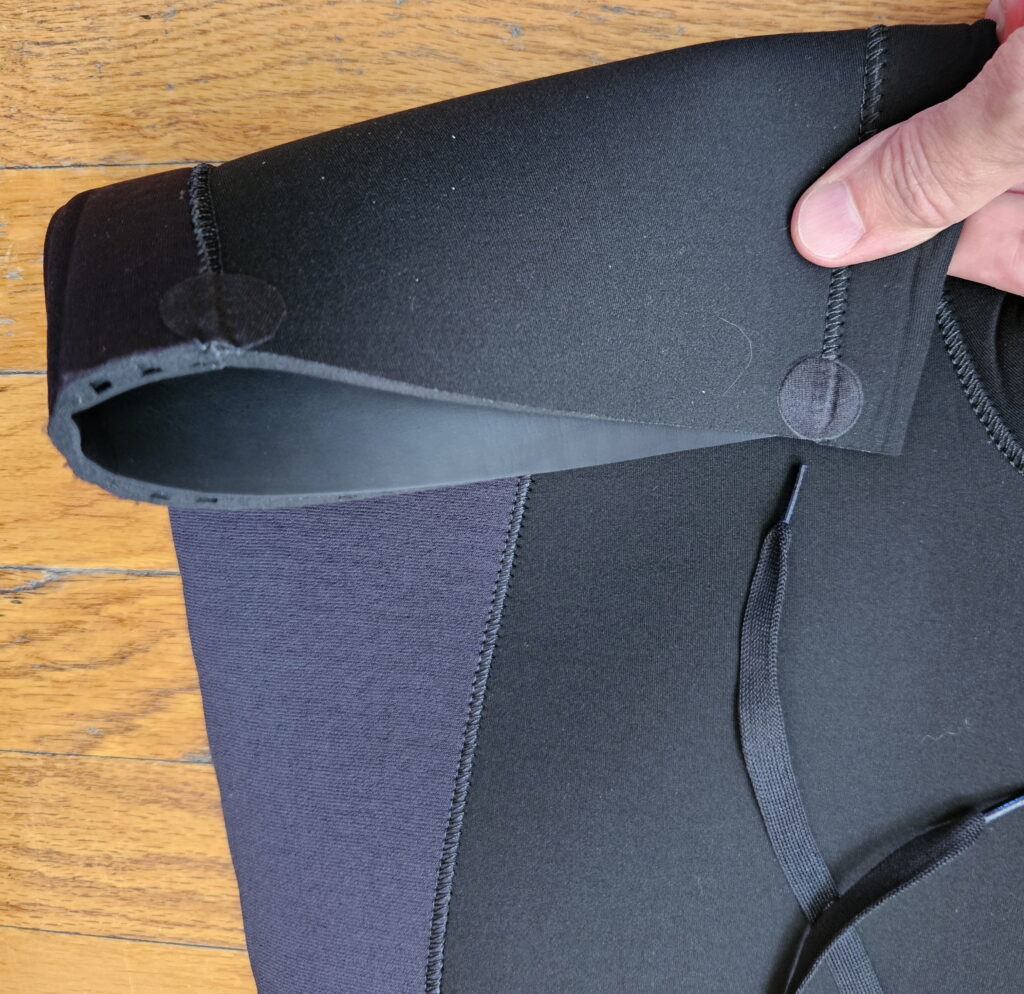
SCS Aerodome neoprene on the leg front has air pockets for additional buoyancy without bulk
The SCS neoprene gives amazing flexibility; these peel off nearly as easily as a jammer, which matters after a long set when your hands are tired or or cold. (One practical note: the flexibility that makes these easy on/off means the waistband drawstring needs to be tied firmly; a loose waistband on a very flexible suit can scoop water.) A nano coating gives good drag-reducing hydrodynamics.
We’ve gotten a year and a half of use with the shorts still in good shape. The Zone3 Premium uses the same materials as Zone3’s high-end Aspire and Vanquish wetsuits.
So, for a swimmer who wants maximum lift in the water, the Premium is the answer. Though it’s worth acknowledging: some amount of buoyancy can be too much of a good thing. If your body position is already good, excess lift can actually disrupt your stroke rather than enhance it, or even cause uncomfortable posture or back pain. The Active is probably the better choice in that case.
Other Options Worth Knowing
The 2XU Propel Buoyancy Short offers another strong option: premium neoprene, hydrodynamic coating for reduced drag. Easy on, easy off, good buoyancy; a legitimate alternative if Zone3 isn’t the right fit.
The Synergy Triathlon Wetsuit Buoyancy Shorts are a solid, general-purpose option for somewhat restrained buoyancy. In a 4:3 configuration (thinner than the Premium, Originals, and 2XU) might be appropriate if you’re not ready for the minimalist Active. Also, Synergy offers a 1 year warranty to the original buyer of the shorts.
If you’re uncertain whether this category is worth the investment and want a proof-of-concept before committing, there are inexpensive options. Goldfin offers a simple 2mm neoprene short and Realon produces a 3mm model; both a fraction of the cost of the engineered options above, but sufficient to confirm whether the sensation of elevated hips and improved body position translates to something you want to train with regularly. We’d expect them to lack the durability of the premium models and the refined hydrodynamic construction, but might work as a first test or for a little more warmth in the water.
Durability and Practical Notes
In pool use with regular chlorine exposure, we’ve gotten long use from Zone3 shorts. For all neoprene swim gear, a fresh water rinse will extend that lifespan.
One thing neoprene swim shorts are not: a substitute for stroke technique development. They make efficient body position easier to achieve, which lets you feel what correct swimming feels like and build from there. The Active in particular is designed as a bridge from higher buoyancy to going non-wetsuit for your event or race. The right model may change as your body position does.
For our Winter 2026 pool training, neoprene swim shorts remain a regular fixture alongside pull buoy and no-neoprene sets. When Lake Michigan opens up for the season, we’ll already remember what the full wetsuit feels like.