Getting Better at Swimming: Video Coaching Works Better Than Watching YouTube
YouTube swimming coaches offer something useful; hours of technique instruction, visual comparisons, and corrective drills for nearly every stroke flaw imaginable. But there's a gap between watching someone fix crossing over in a stranger's freestyle and knowing whether that's your problem at all.
Date: April 11, 2026
There’s no shortage of excellent swimming instruction on YouTube. Channels like Effortless Swimming, Global Triathlon Network (GTN), SwimVice, and MySwimPro collectively offer hundreds of hours of instruction, in some cases with real swimmers with real flaws getting real corrections on camera. The coverage is wide enough to serve beginners through advanced, swimmers training for races or who just want to feel better in the water.
There’s not a flaw in the content itself, but there’s a structural limitation in this. If a channel is correcting problems you don’t have, or perfecting a detail you already handle well enough, watching that video doesn’t help. Swimming instruction on YouTube is for broadcast; it goes out to everyone. Your stroke goes out to no one until you put it in front of someone qualified to look at it.
Why Get a Coach
We wrote previously about how to film your swim stroke, assembling a useful set of video views to see what’s happening. That post approached the subject mostly from the angle of self-coaching. And self-review has real value: the most glaring problems are often visible to anyone interested in swimming.
A coach brings something more: a trained eye that can prioritize what needs attention first. Not every technique flaw deserves equal attention, and some are symptoms of bigger issues that can’t be fixed in isolation. And the list of 8 stroke issues that OpenWaterLog has been trying to fix is too much. A short list of the biggest problems can can focus attention where it’s needed.
We Tried It: USMS Video Stroke Analysis
We’re halfway through the USMS Video Stroke Analysis program and have already found it genuinely useful. At $110 (for USMS members, annual membership costs $100) the package includes an initial analysis and a follow-up check-in after you’ve had time to work on what was identified.
Communication is structured around OnForm, a video coaching platform that allows video exchange and commentary in both directions. You upload your footage, the coach annotates and responds, and you can follow up with questions.
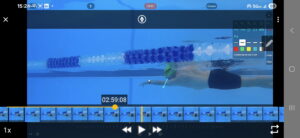
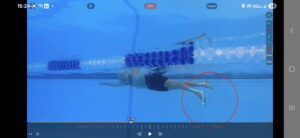
USMS assigned the coach based on an intake, and he proved to be an excellent fit. We’ve completed the first step. The coach was clear about priorities: learn hip-driven swimming with a controlled kick, watch arm position like crossing over and entry, and point your toes back, not down. Three things, ranked, with specific drills (sometimes supported by instruction videos from the USMS library). The focus on 3 main issues was worth the investment alone. But some of the specific guidance about rotation seems to address a big, central neglected problem.
We’re not yet at the check-in stage, but looking forward to taking some video for a self check, then sharing with the coach to reassess.
Other Options
Besides the USMS program, there are several other options.
Tri Swim Coach — This is an experienced coach with an open water swimming focus. He works with triathletes and open water swimmers primarily through remote video coaching. Emphasis on freestyle technique, breathing, posture, timing, and stroke mechanics, especially for people who feel stuck, feel inefficient, are worried about making cut of times or know something is off but can’t quite sort it out on their own. The emphasis on open water swimming mechanics catches our eye and might be a contender for our next round of efforts to upgrade.
Tower 26 — Remote video analysis at $225. Tower 26 has a strong reputation in the triathlon community for structured swimming development. For swimmers in Southern California, there’s an active in-person program as well.
GoSwim — App-based, training platform with access to video content and tracking of swim metrics, and other support for $99/year. The also offer remote coaching as an additional service and cost through their GoSwimMarketPlace.
New Tech for Swim Stroke
eolab is building something more instrumented: their SwimBETTER device is designed to measure the force and directionality of your stroke, similar in concept to what power meters brought to cycling. The idea is to complement visual assessment with actual measurement; not just whether your catch is early, but whether your stroke is generating force in the direction that actually propels you forward, rather than sideways or upward.
It’s early days for this tech. We haven’t tested it, and the price point currently puts it in premium territory. But the direction makes sense, and the technology will likely become more accessible as the category develops.
Why Should I Do This?
You don’t need to be racing to have a reason to swim better. A cleaner, more efficient stroke means swimming further on the same effort, moving through the water with less resistance, spending more time in that suspended, weightless state that keeps most of us coming back to open water in the first place.
Video coaching, even a single session, can start or accelerate that progress. If you’ve already put in the effort to film your stroke, getting a trained set of eyes on that footage is a natural and well-priced next step.