Mackinac Bridge Swim 2025 Report
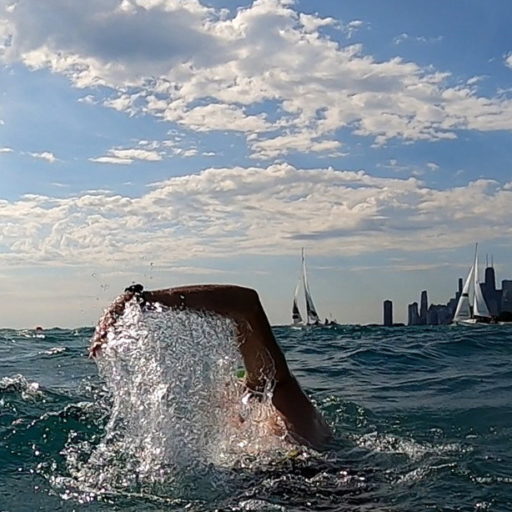
Open water swimming conditions at the Mackinac Bridge Swim 2025 were nearly perfect. It still required careful preparation, good gear selection, and a big effort to complete the 4+ mile swim across the Straits of Mackinac.
The waves were few and small. In the week leading up to the Mackinac Bridge Swim, Openwaterlog.com forecast waves of less than 0.5 feet (0.2m) which was spot on with what 266 swimmers found on the horizon on the morning of July 27.
Chasing the Towers
There was a steady current from east to west that wasn’t hard to navigate while swimming. Though every stop to rest, drink, or take a picture led to quickly drifting under the bridge toward Lake Michigan, and had to be paid back with a quick extra swim against the current back to the prescribed swim lane on the Lake Huron side of the bridge. But a lot of pictures were taken. See more at our Gallery. We all counted ourselves lucky to have beautiful weather and great open water swimming temperature around 70˚F (21˚C).
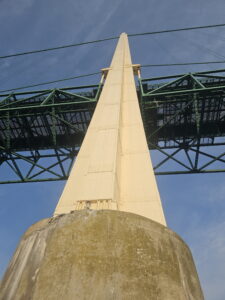
It was enormously helpful to have the succession of concrete piers beginning immediately after pushing off from the shallow, rocky water entrance. Unlike the unchanging Upper Peninsula of Michigan on the horizon, the piers give a recurring indication of progress (~125 yards/114m each pier) out to the south anchorage of the suspension bridge at pier 17. This is a little more than a mile from shore, then a short swim further reaches the south tower (~1.5 miles/3km total). At this point it seems doable. Another push (~0.75 mi/1.2km) across the main span and you’re looking up at the north tower. Could it actually be downhill to get across from here? No, but confidence is high with the big span and towers behind, even though 2 miles/3.2km remain.
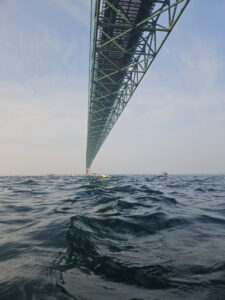
Maybe it’s the building fatigue, but some of this next section feels anti-climactic, swimming along the section of the causeway at the north end of the crossing, rather than under the towering bridge, at places in relatively shallow water. But crossing under the roadway through a tunnel opening in the causeway, to see the finish line, cures this. A raucous crowd awaits, cheering propels swimmers to the finish.
Preparation
Preparing for the Mackinac Bridge Swim was different than previous organized summer swims for OpenWaterLog, particularly given the distance. For us, swimming has always been less about extreme performance (speed) or extreme distance (typically in good conditions in mid-summer 1–1.5 miles [1.6–2.5 km] is plenty) and more about celebrating the experience of living near Lake Michigan and getting in the water as often as possible. So, in addition to the incentive of the terror at the much longer distance (in the end, about 7 km / 4.25 miles) and the range of possible conditions, this year needed to be different in training, nutrition, and swim gear.
On one hand, swimming significantly longer than before (both in training and on the big day) requires simply a larger version of the old swimming routine. On the other hand, there are some implications of this larger plan.
Building Distance
The training plan for distance was to accumulate increasing yardage, beginning in the pool through the winter, building up to 8-10,000 yards/week by May. Once Lake Michigan was fit for something other than winter cold plunges, this pool yardage migrated steadily to the open water, and continued to increase up to 12,000 yards (~11km) or more per week. The most important distance progression was one increasingly longer swim every week over the last 6 active weeks before the race building up to a longest continuous swim of ~7,500 yards (~7km). Tapering down significantly from this build yardage for the next two weeks before the race worked well to recover and feel rested with fitness intact.
Finding Time
Usual open water swims of a mile or a little more fit neatly neatly on weekend mornings before swim sites are crowded, or even before the workday. Preparation, swim, and transition to work might require up to 90 minutes. On the other hand, when increasing morning swims up to 4km and above, the time commitment required a hard early start. The daylight constraint is relaxed in mid-summer and every minute all the daylight was required sometimes. But the longest swims had to happen on weekends, or days away from work.
Patience for the Long Swims
Both in the pool in the winter and spring, and then in the open water, the Shokz Openswim Pro proved helpful in hours-long swims. Expect a more detailed review shortly. Though the experience of the open water itself doesn’t need any help, and full attention to surroundings is a good idea, the distraction in the pool was completely welcome on long days, and worth a try Shokz Openswim Pro in open water swimming. There was no need for this on event day, though they are permitted in the event.
Where to Swim
Finding where to swim in open water is the main point of OpenWaterLog, so we are spoiled for good options and info about this. But for longer open water swims, the options can be narrower. This is because swimming laps in open water (i.e., two repeats of a 2k route to make 4k) turned out not to work well for us. Laps are for pools, not open water, and turning around to repeat a route genuinely diminished the joy and drive to complete the swim.
So the best option for training for long continuous open water swims in Chicago is swimming early in the morning north from Montrose Beach. Going north from the Ledge or Montrose Beach avoids any harbor entrance crossings or obvious obstacles for as far as one wants to swim up to Juneway Terrace Beach at the border with Evanston. We needed only to swim a little beyond Hollywood/Osterman Beach to the street end beach at Thorndale Avenue and back to equal the MBS distance.
Rough conditions and Waves
We generally prefer to avoid these. Living close to Lake Michigan means it’s possible to be selective, avoiding the rough days (we’re all about Finding Good Water after all), embracing the best and flattest water. This was a usual practice in prior years. But the Mackinac Bridge Swim route at the confluence of two lakes in the narrow Straits of Mackinac makes it prudent to expect waves. So training had to include, even on the long swim days, some exposure to heavier surf. OpenWaterLog’s location pages show you a forecast of wave height for the coming 5 days, so it’s possible to arrive to the water mentally prepared for challenging conditions. It turns out can Good Water can include significant waves as well.
Hydration
A 30 minute swim doesn’t require hydration. A 2 hour swim while wearing a wetsuit in water over 68˚F (20˚C) left us dehydrated. This swim was likely to be closer to 3 hours. The Mackinac Bridge Swim obligates participants to wear wetsuits, so most training, other than the warmest water days and short swims, included neoprene. Taking in water, beyond the inadvertent and generally unproblematic sips of a freshwater lake, would be necessary. A water bottle is one option and fits neatly into the external pouch of the Orca safety buoy. But this is a limited amount of water and on big swim days the bottle is competing with a lot of important other things that need to be in that same pocket (phone/camera, nutrition in the form of gels, maybe an extra swim cap (if a water temperature drop is forecast by openwaterlog.com), etc. In the end a filter straw was the answer: the Membrane Solutions Straw Water Filter for open water swimming proved to work well in training. It’s small (~7′ long x1″ diameter/18×2.5cm) and light enough (~2 ounces/ 57g) to fit in the pocket of the Orca buoy. Taste of the lake water is tolerable in the first place (not taking this aspect of Lake Michigan for granted) and the straw made it completely so. Certified by NSF & SGS for producing potable water from appropriate fresh water sources, no GI issues were encountered in training or event day. The straw advertises safely removing microplastics, particulate, and as well as harmful microorganisms from natural water sources. It does not desalinate seawater, unfortunately; this is for use only in fresh water that’s not (read the item instructions) heavily contaminated.
Nutrition
Like hydration, the nutrition requirements of a long swim can’t be ignored. The vast majority of our swims over the last 10 years were less than an hour, in the morning, completely fasted, and with no in water nutrition. Maybe not optimal, but was never problematic. However our experience training for the Mackinac Bridge Swim (and research in general) shows that it’s necessary to fuel before and during a longer (>60 minutes) efforts. For numerous open water swims longer than 2 hours especially, our experience was that fueling needed to dial in effective feeding practices in previous days, an appropriate pre-swim meal, and some in-water nutrition. This one fueling change made some long swims go much better than in prior years.
- Pre-swim — After testing a lot of breakfast options, the one that proved best was a baked potato, skin off: complex carbs without excessive fiber, protein, sugar or fat. This replaced high-fiber alternatives like oatmeal. Overnight oats has been a favorite for years, and seems to deliver the virtuous nutritional value of and the all-day fuel of high fiber whole grain carbs. But that high fiber requires a lot of digestive activity that distracted from the effort of swimming. The same goes for high protein (yogurt), sugar, and fat.
- In water nutrition for open water swimming was best with Gu gels. With variations that include with/without caffeine, varying levels of electrolytes (higher sodium versions for warmer water swim days or almost any swim day in a wetsuit), and more/less sweet flavor options, it was easy to find the few that worked best. The benefit of the in-water gel on some days was palpable, immediate burst of energy from the cabs, and more so with caffeine. Conversely, the inadvertent experiment of leaving nutrition on shore in the next-to-last long training swim in the progression (6500 yards) was a painful lesson, leaving two of us completely drained by the end, and struggling to finish.
Gear
Obviously gear choices are important. Wetsuit and an open water swim buoy are both obligatory at the Mackinac Bridge Swim, and both offer opportunities to improve swim comfort and performance.
Wetsuit
It’s important to point out that preferences for warmth and range of thermal neutral zone vary widely among swimmers — find what works for you—but here’s how we saw the options. On event day, temperatures in the high 50s˚F (13–14˚C) to mid-70s˚F (23–25˚C) are possible, and can even span that whole rang, as in the 2022 event. (The current of the Straits of Mackinac changes direction on an average of once every 1.5 days and can bring big swings in sea surface temperature). The extremes require different wetsuits: 76˚F / 25˚C can cause overheating except in the lightest suits; the low end requires generous neoprene coverage.
This also seemed like an appropriate time to confirm what kind of tech might improve speed and comfort.
- If comfortable mid-range water, within a few degrees of 70˚F (21˚C) seemed likely, the options for best tech, comfort and performance were the Orca Apex Flow V2 and Athlex Flow V2. These boast
-
- Hydrodynamic Super Composite Skin (SCS) finish on the surface of the suit. The Apex Flow also claims improved body position in the water both in how the legs and torso buoyancy are managed.
- Neoprene thickness of 2mm (Athlex) and <1mm (Apex) with improved “shoulder patterning” made for great shoulder flexibility, nonrestrictive almost like a sleeveless. A bit of warmth in the shoulders and arms.
- A balance of warmth and buoyancy that proved to give the right amount of buoyancy for this adult-onset swimmer. Not full coverage of thick neoprene throughout the legs (like the DeSoto T1 Black Pearl below, which is great in cold water) but with air pockets located between the two layers of neoprene and selectively thicker 4/5mm panels in parts of the legs and upper body.
- Tested over longer swims and in a variety of conditions, the Flow worked best: swim times were reliably better. Water temperature coverage was sufficiently wide. The thinner material in the arms of the Apex flow gave incredibly comfortable and unimpeded shoulder movement, hard to differentiate from a sleeveless, so this was our choice for most mid-range conditions.
- Orca offers a distinct women’s version.
- If temperatures were forecast to spike on event week, sleeveless would be better. The Orca Vitalis Light Openwater Sleeveless was our choice, a balance between comfort in warmer conditions and buoyancy.
- If cooler water, go with a very warm wetsuit. The DeSoto T1 Black Pearl Pullover Wetsuit which proved effortlessly comfortable in water as cold as 55F (13C), thanks to full 5mm leg neoprene and the two piece construction that layers 2mm neoprene in both the bibjohn and pullover on the torso.
In the week leading up to the Mackinac Bridge Swim, Openwaterlog.com forecast temperatures ~70˚F (21˚C), so the Orca Apex Flow made the trip to Michigan.
Other Gear
- The most comfortable goggles matter in a multi-hour swim. After swimming all summer in the Snake and Pig Basilisk as described in this blog post, nothing else was considered.
- An open water swim buoy is obligatory at the Mackinac Bridge Swim, our choice is well established as the Orca Safety Buoy with Pocket, precisely because of the pocket and the ability to stash a straw water filter, energy gels, and a phone in Waterproof phone case for taking photos from the water.
It all worked well. Mackinac Bridge Swim 2026 (July 18) is already on the OpenWaterLog calendar.